There’s a certain kind of neighbor who stands on their property line and tells you exactly what you can and can’t do on yours.
They’ve read the rules. Or they’ve skimmed them. Or they’ve decided that the spirit of the rules and their personal preferences are close enough to be interchangeable. Either way, they know what’s allowed. And what’s allowed is whatever doesn’t bother them.
Nextdoor is that neighbor.
Which is impressive, really. Building a platform specifically designed to document that neighbor, and then becoming them. That takes commitment.
How It Started
In early May, I wrote a post. Not a press release. A post. First person, specifically about the experience of living where I live and hearing what I hear at the hours that I hear it. I wrote about noise. About calling BSO. About code enforcement. About the feeling of documenting something carefully and watching nothing happen anyway.
164 reactions. 162 comments. Neighbors I’d never met, sharing their own versions of the same story, asking where they could read more.
So I wrote another one. And then another. And then one about something completely different. Cars parked on front lawns and converted driveways. Because that’s how neighborhoods work. More than one thing happens in them.
I wrote five posts over about ten days. One of them went places I didn’t expect. The rest found their audience too, smaller but real. People were reading. People were responding. People were, by every available measure, not feeling spammed.
Then someone filed a complaint.
A Brief Portrait of the Neighbor Who Reported Me
I don’t know who reported me. Nextdoor doesn’t tell you. That’s by design. You just find out it happened, with no indication of who did it or why, which is its own interesting policy choice for a platform whose entire pitch is community transparency.
But I know the type.
This is not the neighbor who wants the rules enforced. That neighbor and I are on the same side. The neighbor who reported me read a post about inconsiderate neighbors and didn’t see a relatable situation. They saw a mirror. Those are very different reading experiences.
They didn’t comment. They didn’t knock on the door. They didn’t turn anything down. They went looking for a tool that would make the documentation stop, and they found one. Reporting a post on Nextdoor starts with a list of reasons: Dangerous or illegal, Discriminatory, Misinformation, Disrespectful, Copyright/trademark, and Other. Other open a second list. That second list includes Spam, and it also includes Irrelevant or annoying and Goes against my beliefs, values or politics. Those last two are right there, one tap away from a formal complaint.
Reading the community guidelines before filing a complaint requires the same thing reading a noise ordinance requires before cranking the speaker to eleven. The willingness to consider that the rules might apply to you.
The most motivated person to report a post about inconsiderate neighbors is, if we’re being precise about this, an inconsiderate neighbor. The posts found exactly the audience they were written about. That audience used the only tool available to them that didn’t require turning anything down.
They filed a formal complaint instead. Because when you’ve decided that someone else’s voice is the problem, the mute button feels like not quite enough. You want the platform to agree with you. You want the platform to act. And Nextdoor, to its lasting credit as a community trust-builder, obliged.
What the Community Guidelines Actually Say
I read them. All of them. Not because I expected to find a loophole, but because when someone tells you that you’ve violated a rule, the reasonable response is to go read the rule.
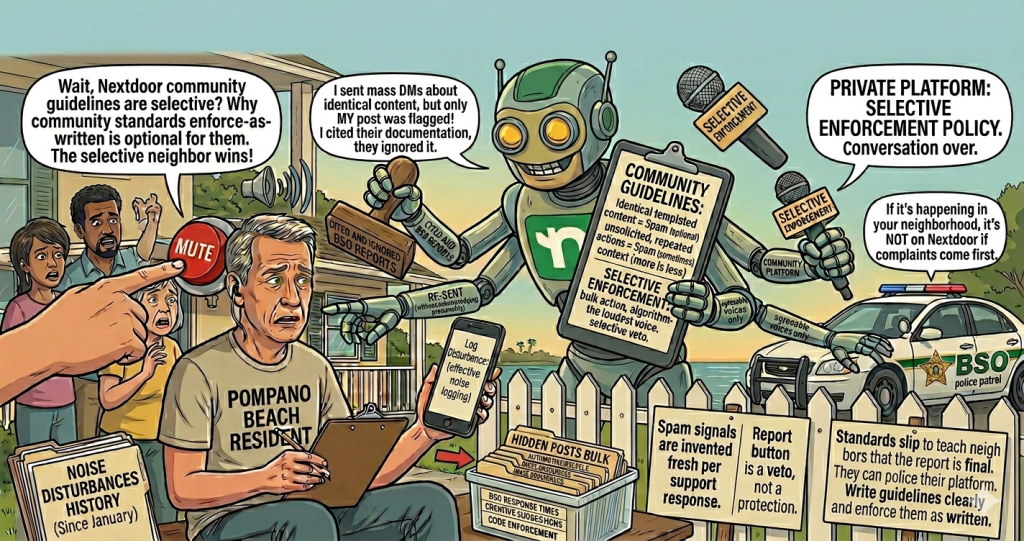
Spam, according to Nextdoor’s own guidelines, means unwanted, unsolicited, repeated actions that negatively affect neighbors and the community. Mass DMs. Identical templated content. Posts with nothing but a link and no context.
I sent no DMs. Every post was original. When I linked to my blog, I posted the full article text directly in the feed, because “only a link without context” is listed as a spam signal and I wanted to do the opposite of that. I overcorrected so hard in the direction of providing context that a handful of comments included complaints about length. That is a different problem, and one I am at peace with.
The post with the most engagement had no blog link at all, because the blog didn’t exist yet. The blog exists because neighbors asked for somewhere to read more. That is not driving traffic to a commercial venture. That is a neighborhood telling a neighbor to keep going.
For the record, Nextdoor’s stricter self-promotion rules, the ones that took effect in March, apply to specific test counties in Florida. Broward County, where Pompano Beach sits, is not one of them. I raised this in my appeal. It was not addressed. Presumably because addressing it would have required acknowledging it.
The Part Where Nextdoor Acts Like That Neighbor
When I pushed back, with specifics, with citations from their own documentation, with a point-by-point explanation of why none of the listed spam behaviors described what I posted, Nextdoor referred me to the Community Guidelines.
I had cited the Community Guidelines. To Nextdoor. In writing. With page references.
They sent me the link anyway.
This happened across three separate responses. First, it was spam. Then it was overposting, with the helpful suggestion that I consolidate my posts about noise ordinances, BSO response times, code enforcement inaction, car storage, and creative suggestions for inconsiderate neighbors into a single post. One post. Five topics. That was the note. Worth mentioning here: one of the hidden posts was The Automotive Shuffle, which is about cars parked on residential property and shares no topic, no argument, and no subject matter with any of the other posts. It was flagged for posting the same or similar content. No one read these individually. Something triggered a bulk action, and the algorithm followed it without looking up. The third response informed me the content could not be restored due to violations linked to the posted content, thanked me for my understanding, and closed the door.
Violations linked to the posted content is not a guideline. It is not a standard. It appears nowhere in the documentation I had spent three exchanges citing back to them. It is a sentence that contains a period and nothing else useful.
Three responses. Three different rationales. Zero overlap with anything published.
That is not a support process. That is creative writing with a ticketing system.
This is the neighbor who, when you point out that the city ordinance does not actually require what they’re insisting upon, tells you to review the ordinance and closes the door. The ordinance is not the point. The point is that the conversation is over and they’d like you to feel like it ended correctly.
Nextdoor would like you to feel like it ended correctly.
What This Is Actually About
I’m not standing in my front yard claiming my First Amendment rights were violated. Nextdoor is a private platform. They can police their system however they see fit. That’s not the argument.
The argument is simpler. If you’re going to have community guidelines, write them clearly and enforce them as written. Not selectively. Not in response to whoever files a complaint first. Not under standards invented fresh per support response. The guidelines exist to protect every neighbor equally. The one writing the post and the one who doesn’t want to see it.
When those standard slips, the cost isn’t just to the neighbor whose posts disappeared. It’s to the next one who has something true and specific and uncomfortable to say and decides not to, because they’ve seen what happens. A platform that allows complaints to function as a veto over content that doesn’t actually violate anything isn’t building community. It’s teaching neighbors that the report button is the loudest voice in the room.
That’s the slippery part. Not that one person’s posts got hidden. But the mechanism that hid them is available to anyone, any time, for any reason, including reasons Nextdoor’s own documentation says don’t constitute violations. And every time it works, it works a little more easily the next time.
Nextdoor’s manifesto says “when neighbors start talking, communities get stronger.” It says “share what you know.” It says, “if it’s happening in your neighborhood, it’s on Nextdoor.”
Posts about noise complaints, BSO response times, and code enforcement inaction. 164 reactions. 162 comments. Neighbors finding each other across zip codes over a shared experience they’d never seen documented publicly before.
That was happening in the neighborhood. It was on Nextdoor. Right up until it wasn’t.
It turns out “community platform” is a complicated phrase when the community part gets in the way. A neighborhood where only the most agreeable voices stay visible isn’t a neighborhood. It’s Nextdoor’s version of one. And those, it turns out, are not always the same thing.