They call Pompano Beach “Florida’s Warmest Welcome.” Every year, the city wins an award for its budget. The budget is 271 pages. The award is one page. The one page is what gets framed.
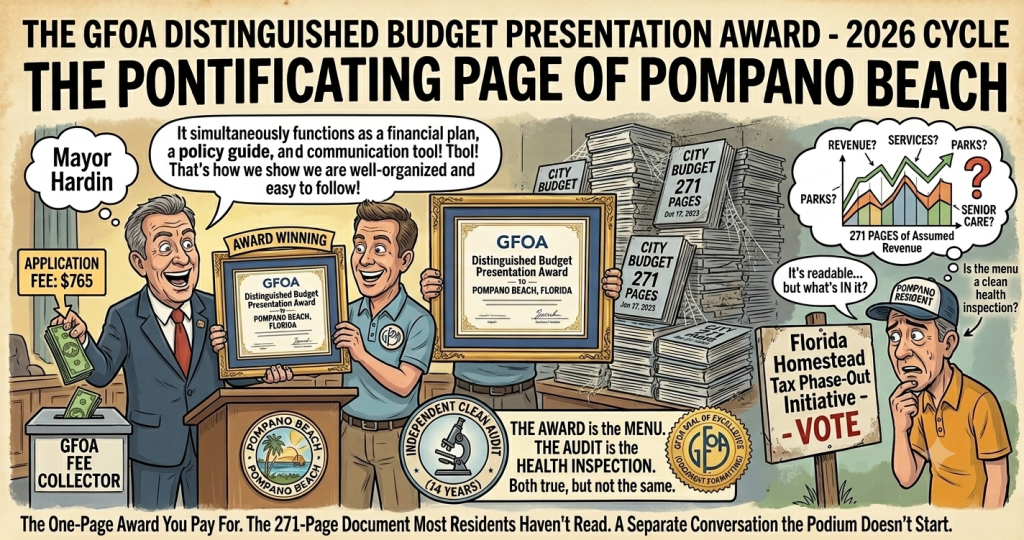
The GFOA Distinguished Budget Presentation Award is administered by the Government Finance Officers Association of the United States and Canada. To receive it, a government must demonstrate that its budget document functions simultaneously as a policy document, a financial plan, an operations guide, and a communications tool. The document is reviewed against these criteria by trained evaluators. If it meets them, the award is granted. The award is valid for one year. At the end of that year, the government may apply again. The process is thorough, the standards are serious, and the result is a formal recognition that the document explaining where your money goes is easy to follow. Which is, the city will be the first to tell you, exactly the kind of thing you should feel good about.
Pompano Beach has applied every year since 2015. Every year, the award has arrived.
The application fee for a city of Pompano Beach’s size is $765. This is paid annually. With city funds.
Approximately 1,900 governments receive the award every year. States. Counties. School districts. Transit authorities. Water management districts. Cities of every size, in every state, that submitted a budget document and met the criteria. Each of them received the same award. Each of them paid the fee. Each of them received the same certificate that appears in their annual budget document as a seal of fiscal excellence. The seal does not know how many other seals there are. The seal is not troubled by this. The seal simply exists, and the budget document is better for having it. The budget document has not asked any follow-up questions.
At his 2026 State of the City address, Mayor Hardin offered the larger credential: 14 consecutive years of clean audits. Zero findings. Independent auditors reviewed the city’s financial statements and found no material problems, no compliance violations, no internal control failures. He told the audience the streak “allows us to borrow funds at lower rates. That’s how you keep quality high and taxes low.” This is a real thing. A clean audit is a substantive standard. An independent firm is examining the numbers, not the formatting. These are different exercises. A restaurant can pass a health inspection and still charge too much for the soup. Both facts are true. Neither one is the other. The award is the menu. The audit is the health inspection. Neither one tells you if you are going to enjoy the meal, and neither one is picking up the check.
The budget presentation award does not examine the millage rate. It does not examine where the money goes or how efficiently it gets there. It does not examine what portion of new development tax revenue reaches the general fund and what portion is legally committed elsewhere before the city ever sees it. It does not examine the gap between permit revenue at $17 million and permit revenue at $13 million, both of which appear in consecutive well-organized documents, formatted correctly, clearly presented, award-winning. The trend is in the document. The award is for the document. These are the same document. They are not the same thing.
The document has been well-organized every year since 2015. The formatting remains excellent. The criteria have been met. The fee has cleared. The award has arrived. What the 271 pages contain is a separate conversation that the award does not open, the podium does not invite, and most residents will not start on their own, which is nobody’s fault, because 271 pages is a serious personal commitment and the award is only one.
Most residents have not read it. Neither side of any argument about it has. The award does not require this. It requires that the document be readable. Whether anyone reads it is a question the certificate has never once asked, in 1,900 jurisdictions, for more than forty consecutive years, and it does not plan to start now.
November will ask a different question entirely. Florida voters will decide whether to phase out the homestead property tax. If it passes, the revenue assumptions inside that well-organized document change in ways the current award cycle does not address, because the award cycle addresses the document, and the document addresses last year. The criteria remain the same. The fee remains $765. The application opens again in the fall. The document will be well-organized. The award will arrive. The formatting will be excellent.
Florida’s Warmest Welcome. Award winning, every year. The application fee was $765. You covered it.
Very well.