They call Pompano Beach “Florida’s Warmest Welcome.” And as of July 1st, the welcome just got a fence around it. Possibly a shed. The state of Florida would like you to know that neither requires a permit anymore, and I would like you to know that I have already identified three properties within walking distance that have been waiting their entire lives to hear exactly that.
Governor DeSantis signed House Bill 803 into law, exempting certain residential construction work under $7,500 from building permit requirements, effective July 1, 2026. The stated goal is cutting red tape and lowering costs for homeowners. What I have is a front-row seat to what happens in this neighborhood when the tape gets cut, and I want to make sure everyone is emotionally prepared. Particularly the people who live next to someone who has previously required a concrete truck to execute what he described as a quick weekend project.
The law covers things like minor storm repairs, small fences, and outdoor sheds. Reasonable exemptions, in a world populated entirely by reasonable people exercising reasonable judgment. We do not live in that world. We live here. Where “minor renovation” is a phrase that has been used, without irony, to describe decisions that required a concrete truck. Where “it’s my property” is a complete legal philosophy held with absolute confidence by people who have never once read what owning property actually entails.
Electrical, plumbing, mechanical, gas, and structural work still require permits, because someone in Tallahassee correctly identified those as the categories where creativity has consequences. Everything else under $7,500 is now the Free State of Florida. Freer than before, anyway. The neighbor with six cars has been waiting for exactly this kind of news. Not because it applies to him. It doesn’t. But because he read the headline, and the headline said no permit required, and that is all the state of Florida needed to say to make his existing situation feel officially endorsed. He is not reading the exemption list. He is nodding slowly and feeling vindicated. By the government. For the parking situation. This is where we are.
Now. There is a provision buried in this bill that I want to discuss, not because it affects you, but because of what it reveals about us as a species. The law specifically prohibits splitting a larger project into smaller pieces just to stay under the $7,500 threshold. Someone wrote that down. In an official document. Passed by the Florida Legislature. Which means the meeting where this bill was drafted included a moment where a lawmaker looked around the room and said “we need to say this explicitly,” and every other person in that room immediately thought of someone specific. They all have neighbors. We all have neighbors. The provision exists because the neighbor has always existed. The legislature knows. The legislature has simply accepted this and moved on, which is a coping strategy I respect and have personally been working toward for several years.
Here is the part I want to pause on, because this is where the headline and the actual law quietly part ways, and what happens next depends entirely on which one your neighbor read.
The law says: fences, small decks, minor storm repairs. No permit. Reasonable. Targeted. Specific.
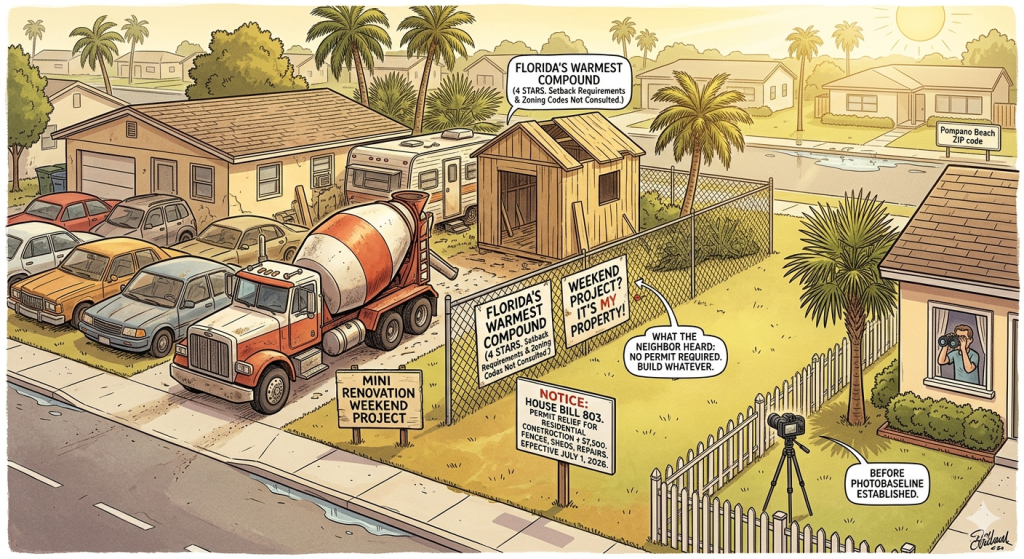
What the neighbor heard: no permit. Full stop. Green light. Go. Build whatever. The government said so. I read it online.
Those are two different laws. Only one of them exists. The other one lives in the same place as the understanding that six cars fit a two-bedroom lot and the camper out back qualifies as a guest suite.
Here is the part where I mention, and I do this purely out of civic obligation and the knowledge that at least one person in this ZIP code is already measuring, that the exemption does not apply to properties in designated flood hazard zones. In South Florida. Where we live. Inches above sea level. On top of a limestone shelf that the Atlantic Ocean considers a suggestion. A meaningful portion of Broward County properties sit in flood zones, which means the permit relief that sounds fantastic in a headline may not apply to your actual house, on your actual street, in your actual low-lying neighborhood where the gutters back up if someone upstream sneezes. FEMA has a flood map. The Broward County property appraiser’s website has your zone. Your insurance agent has your zone, a highlighter, and feelings about it. Feelings they will share with you in detail at the exact moment you least want to hear them.
But back to the fence.
Because the fence and shed exemptions are what’s going to make this summer genuinely memorable. No permit. Under $7,500. Go ahead. And look, in a rational universe, this is a perfectly sensible exemption that helps homeowners move faster on small projects without drowning in bureaucracy. In the universe where I actually live, the neighbor with six cars, six in a two-bedroom driveway, two of which have not moved since the second Obama administration, has been quietly eyeing the remaining patch of grass between vehicle four and the property line. As of July 1st, the concrete can go in without a permit. The cars finally have a permanent home. The grass understood. And the neighbor with the camper listed on a short-term rental platform is pricing lumber. Together, structurally and spiritually, they are building a compound. Florida’s Warmest Compound. Four stars. Continental breakfast not included. Zoning codes not consulted. Setback requirements not consulted. The permit exemption was the green light they were waiting for, which is impressive considering it is not actually a green light for anything they are about to do.
To be absolutely clear, and I want to be clear because one of them reads this blog and I would like this to function as a public service and also a preemptive legal document, this law does not eliminate zoning codes, HOA rules, setback requirements, or code enforcement. “No permit required” means one specific thing: no permit for that specific category of project. It does not mean no rules. It does not mean no consequences. It does not mean your neighbor cannot call code enforcement, which they will, and they will enjoy it. Everything that governed what you can build, and where, and how close to your neighbor’s bedroom window, remains entirely intact and entirely available to anyone with a phone and a grievance. Which, in this neighborhood, is everyone.
HB 803 takes effect July 1, 2026. Check your flood zone. Read the actual exemptions. And perhaps glance out your front window this weekend, just to establish a visual baseline for what the yard next door currently looks like.
You’ll want the before photo.
The fence goes up first.
It always does.