They call Pompano Beach “Florida’s Warmest Welcome.” What the brochure leaves out is that someone has been quietly parking on it.
A standard residential driveway was designed under the quaint assumption that a household owns perhaps two cars. Maybe three if someone recently turned sixteen. That is a charming concept. An opening bid. A vision being stress-tested throughout our neighborhoods with the kind of enthusiasm typically reserved for people who have never once read a zoning code and have no plans to start.
What has emerged in certain driveways, and I use the word “driveway” loosely, the way you might use the word “kitchen” to describe a hot plate, is something far more ambitious. The complete conversion of every square foot of front yard into a personal vehicle storage facility. Not a parking area. Not an expanded driveway. A facility. With inventory.
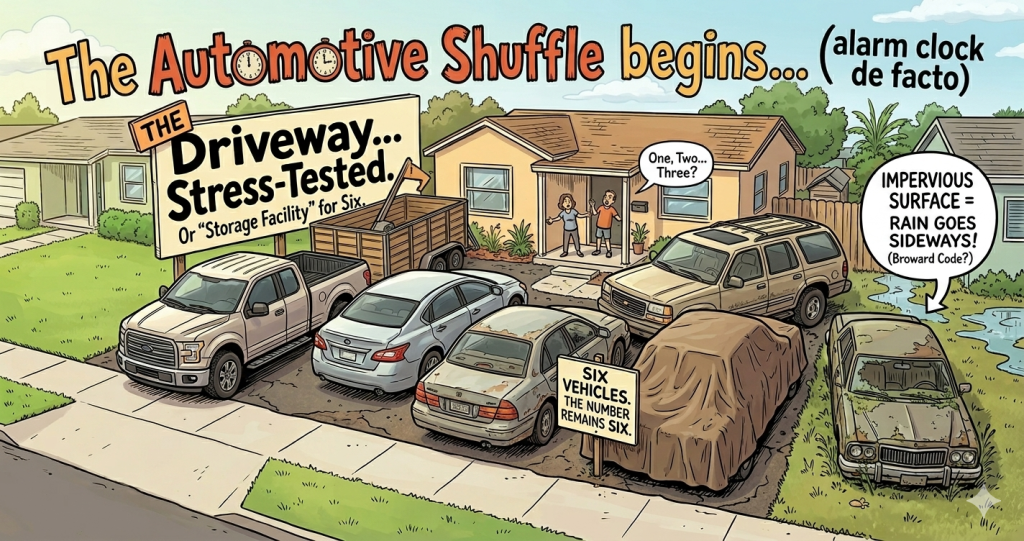
Somewhere in this neighborhood there is a two-bedroom, one-bath, approximately twelve-hundred square foot residence currently hosting six vehicles. I have counted. I have recounted. I have counted again on a different day in case any of them had somewhere to be. The number remains six. There is a pickup truck with a trailer, which is technically two things pretending to be one. Two sedans at different stages of their automotive journey. An SUV that seems to be providing structural support to the vehicles around it. A vehicle under a tarp whose contents, purpose, and legal status remain, at this time, a neighborhood mystery. And a sixth — a sixth — that has not moved since the second Obama administration and has at this point achieved the kind of permanent residency that most people need paperwork for. It pays no rent. It contributes nothing. It has simply decided.
To accommodate this collection, the lawn had to go. The lawn understood. The lawn never had a vote. One weekend the grass simply gave up, And honestly, who could blame it, What was once a front yard, completed its quiet transformation into a staging area for vehicles that outnumber the bedrooms two to one. A ratio that raises questions nobody on this block has figured out how to ask politely.
The landscaping budget was reallocated. Curb appeal now consists entirely of hood ornaments.
And that’s the modest version. Some households skip the slow decline entirely and go straight to concrete. Full commitment, curb to curb, corner to corner, every square foot of former front yard sealed permanently into a surface that will outlast the house, the cars, and everyone currently reading this. No grass to mow. No soil to absorb anything. No ambiguity about what this property has decided to be. It has decided to be a floor.
Then there are the ones who split the difference with gravel. Bags and bags of gravel, raked into a flat, featureless expanse from property line to front door. Not concrete. Not grass. The visual equivalent of giving up, but with a certain mineral dignity.
And then, and I want you to appreciate the artistry here, there is the neighbor who paved the entire front yard in concrete, wall to wall, vehicle to vehicle, and then carved out one precise circular cutout to save a single tree. Just the one. Standing alone in its little ring of exposed dirt like a survivor. Like a mascot. Like a tree that won something the other trees didn’t even know was a competition. Whatever that tree did to earn its circle, it should feel proud. The lawn is gone. The soil is gone. Six cars have taken up permanent residence. But the tree has a reserved space, a concrete border, and apparently leverage.
There is, I will admit, an organizational philosophy at work. The vehicles are arranged with intention. It is not a system I can fully decode from the street, but it is clearly a system, because certain vehicles are inaccessible without moving other vehicles first, which requires moving other vehicles, which on weekend mornings produces a choreography of reverse beeping, diesel idling, and door-slamming that functions as the neighborhood’s de facto alarm clock. You didn’t set an alarm. You didn’t need to. The automotive shuffle begins at seven. It concludes when someone successfully exits the formation and makes it to the street, or gives up and orders an Uber, which arrives at the curb, briefly adds a seventh vehicle to the tableau, and leaves looking slightly confused. The driver gives it three stars.
It is worth noting, as a point of purely neutral geographical interest, that Florida receives approximately fifty inches of rain per year. More than Seattle, which has built an entire cultural identity around considerably less and at least has the self-awareness to carry an umbrella. Grass absorbs this rain and filters it into the ground, which is where the ground generally prefers it to go. A former front yard now covered in concrete, compacted dead soil, and six vehicles with various levels of commitment to ever moving again does not absorb anything. The water goes sideways instead, into the street, the storm drain, and your neighbor’s yard, which is now performing the hydrological function of two properties because yours quietly opted out of the natural order of things sometime around 2014. This is not an editorial position. This is just water, doing what water does, going places it was not invited, much like the seventh Uber.
Broward County has impervious surface regulations. Municipalities have zoning codes specifically addressing vehicle storage in residential zones. These documents exist, are public record, and can be located in under sixty seconds using any internet-connected device, Including, presumably, the one currently being used to track the Uber navigating through the parking situation next door. Mentioning this purely as a public service. As one does.
Not everyone will relate to this. Some people live on streets where the number of vehicles in the driveway bears some relationship, any relationship, to the number of bedrooms in the house, the grass is green, and the rain goes into the ground more or less where it lands. I have seen photographs of these streets. They seem nice. Quiet, even.
This is for everyone else. The specific subset who know exactly which house this is about. Those who have watched the morning shuffle from a front window, who have done the math on the bedroom-to-vehicle ratio and arrived at a number that doesn’t make sense, and who have thought, at least once: I should count those.
The answer is six.
The tarp is still on.
The lawn is not.
The tree, for what it’s worth, is doing great.